
Bevendean History Project

Falmer Stories and Photographs 1
Beating Retreat on Madeira Drive on Friday 2 August 1935
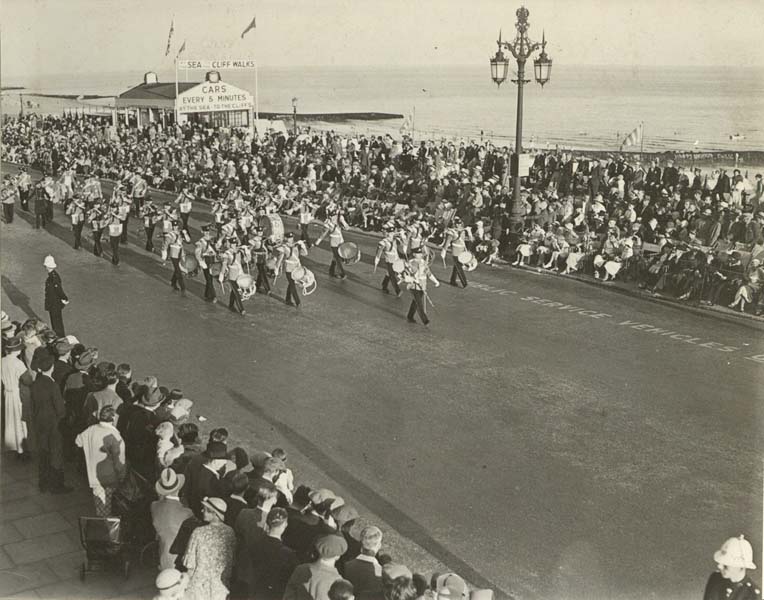
The ceremony of “Beating Retreat” on the Madeira Drive yesterday (Friday) evening.
Keep Reference: BH/A/54/01_0052a
2000 Territorials in Mock Battle
Hollingbury Camp as “Objective”
Airplanes and Guns
Over 2000 territorials are to take part on Wednesday and Thursday next in the mock battle on the Downs near Brighton.
Airplanes and light and heavy artillery are to be used in the battle which will rage throughout Wednesday through part of the night and end on Thursday. It is hoped that armored cars will be used.
The men taking part are London Territorials in camp at Falmer.
The Herald was informed by Colonel C F Liardet D.S.O. officer in command, that Ditchling will be the centre of the operations and the battle will move towards Brighton, reaching its final stage at Hollingbury Camp which is the last objective.
Colonel Liardet will be in charge of the battle by means of wireless and field telephone. Special cables have been laid for the phones and the control will also keep in touch with the brigade commanders by direct wireless communications. Sets for both transmission and reception by direct speech are carried in baby cars attached to each unit.
Aerial Spotting
In the battle over 50 guns of calibers ranging from 18 pounders to 60 pounds will fire blanks while airplanes will carry out reconnaissances and take photographs of the movement of the different units. By this means the officers will be able afterwards to see how each unit carried out its own operations; the photographs, in fact, will form an incontrovertible record of the work performed whether good or indifferent. Each battery officer will be on his toes to see that the aerial eye does not observe any of his errors of omission or commission. Some of the batteries will be camouflaged against observation It remains to be seen whether they will be spotted from the air.
This is believed to be the first occasion on which territorials have taken part in manoeuvres of this magnitude.
During Wednesday night the men will go into bivouac on the open Downs. Now they are hoping the weather will be will keep fine!
All Mechanized
The operations are for the first time all mechanized. No horses are to be used except by the officers in fact the artillery is now almost completely mechanized. The change was noticeable in the camp where large and small motor trucks stood in orderly rows. There are about 200 vehicles of all kinds.
The jingle of the bits and the spurs have given way to the grunt of heavy engines and hum of motor tyres.
The units in camp include the 63rd, 64th and 65th Field Brigades R.A., The 47th Division signals, the 21st, 22nd, 23rd, And 24th Battalions, London Regiment (comprising the 142nd Infantry Brigade), the 47th Divisional R.A.S.C., the Second Cavalry Divisional R.A.O.C., and the 222nd Company, R.E.
Actually, there are two camps, one on either side of the main road. Their white canvas tents can be seen from the buses extending in orderly lines over the Downs. The second camp comprising the infantry and the signals, is under the charge of Colonel M. Beckwith-Smith D.S.O., M.C. On Sunday other territorial units are to enter camp at Roedean.
“Beating Retreat”
About 5000 people watch the band of the 23rd Battalion of the London Regiment beating retreat on the Madeira drive yesterday (Friday) evening.
The 23rd are in camp at Falmer and by permission of Lieutenant Colonel W. H. C. Le Hardy, M.C., the bands perform the ceremony before the Mayor and Mayoress of Brighton Alderman and Mrs. Gibson and members of the Brighton Town Council.
The Councillors, together with the Chief Constable Captain W. J. Hutchinson and Mrs. Hutchinson and other privileged spectators, watch the ceremony from the Aquarium Sun Terrace, while scores of holiday makers line the sides of the road.
Military parades are always entertaining and the crowd were thrilled by the rhythmic marching of the bandsmen in their scarlet uniforms and white gauntlets the twirling of the drum major staff and the feats of legerdemain performed by the drummers.
The performance will be repeated next Friday.
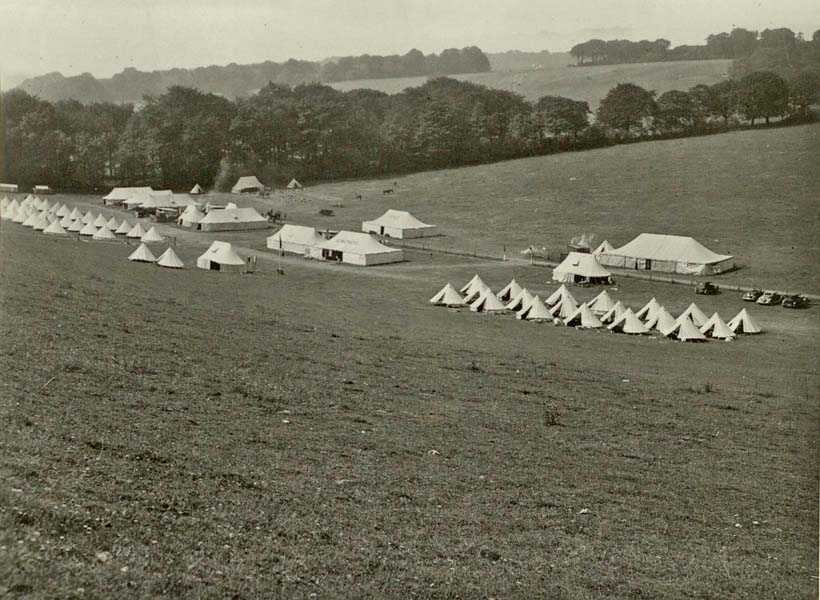
Territorials have arrived at their annual camp at Falmer.
A general view of the artillery camp.
Keep reference: BH/A/54/01_0052b
From the Brighton and Hove Herald on Saturday 3 August 1935
BRIGHTON CAPTURED
Theoretically
Invading Army Wins Battle Of The Downs
Grim Machine War
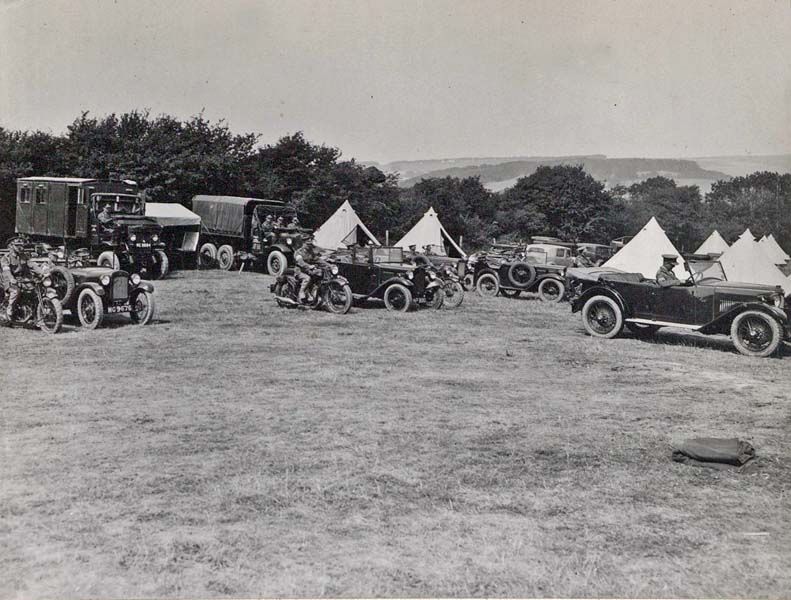
A survey section ready to move off at Falmer.
Keep reference: BH/A/54/01_0060a
A nice little war in which no blood was shed and guns spoke with a bark far worse than their bite ended with the capture of Brighton theoretically speaking on Thursday.
A force from the mythical kingdom or is it a republic of Francoma succeeded in pushing defending forces into the sea in the early hours of the morning. Following a campaign which began in the near neighbourhood of Lewes on Wednesday.
The force of 2000 London Territorials who are in camp at Falmer took part in the battle which was staged with the idea of testing the efficiency of the newly mechanized Territorial Army. Judging from the satisfaction of the Gunnery officers on Thursday the results of the test were highly satisfactory. They were perhaps less satisfactory to the small force of infantrymen who after fighting gallantly throughout, discovered that, technically, they had been wiped out long before.
It was, in fact a campaign which would have given satisfaction to a Pirandello who might have christened it “2000 Territorials in search of a war.”
Small parties of infantrymen had to represent whole divisions, and more than one soldier had the responsibility of personifying a company of men in this mock battle, in which there were only imaginary casualties, the size of which was a matter for the skilled judgment of umpires who accompanied the different units. The umpires’ reports were not expected before the weekend, but an officer attached to the staff of Colonel C. F. Liardet, D.S.O. commanding the Artillery forces, estimated that theoretically 50% of the defence forces were annihilated, while the attackers lost some 25 per cent.
The Attack Opens
The attacking force representing the Franconian invaders were assumed to have landed at Pevensey and have reached, on the evening of August 6th, the district of Lewes. The following morning the attack developed when defenders screen of cavalry was observed.
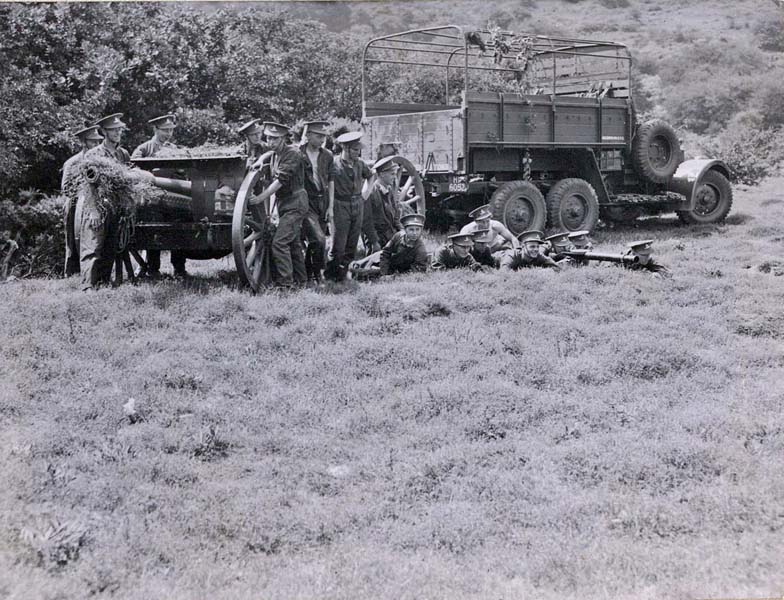
A gun crew awaiting the signal to advance, note the gorse and bracken used to try to camouflage the gun.
Keep reference: BH/A/54/01_0051c
A battery of guns were brought into action the cavalry were driven off and soon in rapid succession Horseshoe Plantation, Street Hill Farm and Mary Farm all objectives within a few miles of Falmer fell before the advance of the invaders.
These skirmishes however were only preliminaries to the main battle which developed in the afternoon near Ditchling Beacon. Here a defending battalion which actually represented a whole division, was met in a strong position at noon. The invaders threw Practically the whole weight of their artillery into the battle comprising some 44 light and heavy guns and at 3:30 the beacon was captured.
In spite of counterattacks the Franconia’s pushed on, at 4:00 they came up against the main enemy position, situated on high ground with upper standing as the centre and it was decided that this position could not possibly be taken that evening.
Accordingly, the forces both attacking and defending Bivouac on the Open Downs while the invaders were preparing for their final attack. Actually, the only work during the dark house was done by signallers, who were busy laying their telephone wires and experts who were preparing by secret survey methods for the artillery attack in the morning. Although this was an official secret, the survey may be described as a new method by which guns can be trained on a target without preliminary range finding shooting the most that could be gathered about it was that it all were it is all worked out by trigonometry.
With dawn, the great offensive was launched. All the invaders’ artillery began to hurl imaginary projectiles onto the defenders’ position, and by six o’clock the whole area north of Upper Standean had been captured. The artillery fire was represented by the firing of 200 rounds of blanks which was quite impressive.
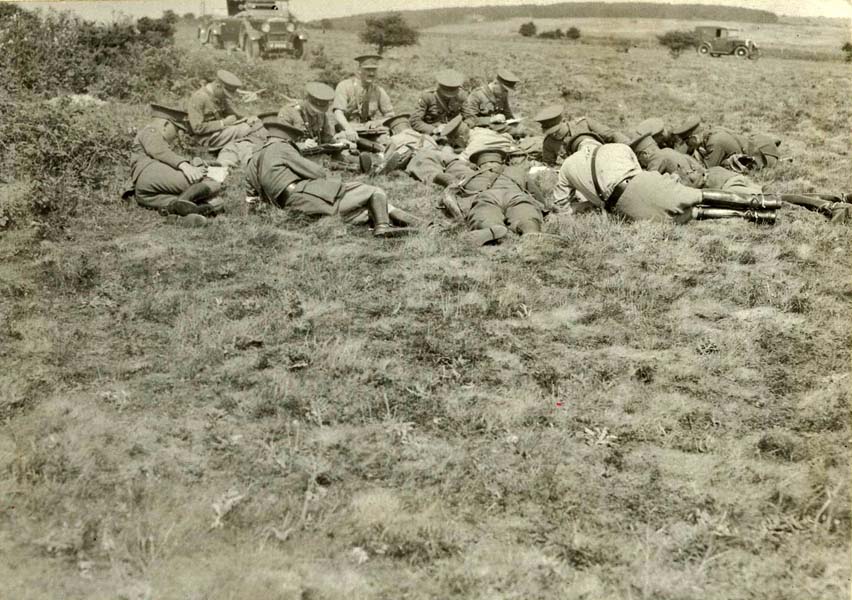
Signal practice at the Territorial Army Camp at Falmer.
Keep reference: BH/A/54/01_0051b
A Theoretical Army
Actually, it hardly mattered what was used, for the infantry who had been representing the defenders had been sent back to camp the night before, and the positions were occupied only by a theoretical army. Still, this army was yet theoretically strong enough to decide the attacking commanders in calling off the battle soon after six in the region of Tegdown Hill above Patcham.
There were a number of domestic reasons for this decision, but it appears that had the attackers continued, the defending force would have been overwhelmed. Hollingbury Camp (the last theoretical stronghold) would have been taken, and shortly afterwards Brighton would have been at the mercy of the invaders.
This as briefly as possible is the story of the tactics of the battle. From the point of the spectacle it was evident that the Territorials had lost a great deal of the picturesque by mechanization. It was a grim war machine The few horses to be seen were ridden by dispatch riders or officers.
There was none of that dashing work by cavalry which had provided the painters with such dramatic subjects in the past One could see only green painted wagons drawing field guns moving uncouthly across the downs or concealed behind clumps of trees from observation by the defenders airplanes.
Here and there were little groups of soldiers talking into field telephones or signaling motorcyclist and little green cars carrying portable wireless sets dashed about, giving some animation to the otherwise almost static scene.
The holder force was lost on these thousands of acres of gorse strewn sand bleached Downland. The attacker’s orders were to remain concealed as much as possible and at no point was it possible to see more than a few men or machines.
Camouflaged Guns
Only the observer in his cockpit might have been able to descry anything more, and to deceive him the gunners had tied fern and gorse all over their machines.
There was something forbidding about this mechanical war, in which the human element seemed to count for so little. One wonders what the reality might have been, with its addition of formidable tanks and poisonous gas. And one came to the conclusion that the best kind of war was the Territorials, which ended with the theoretical victory of one side or another, according to the umpires decision.
And as it was arranged that the attacker should win, everybody was happy!
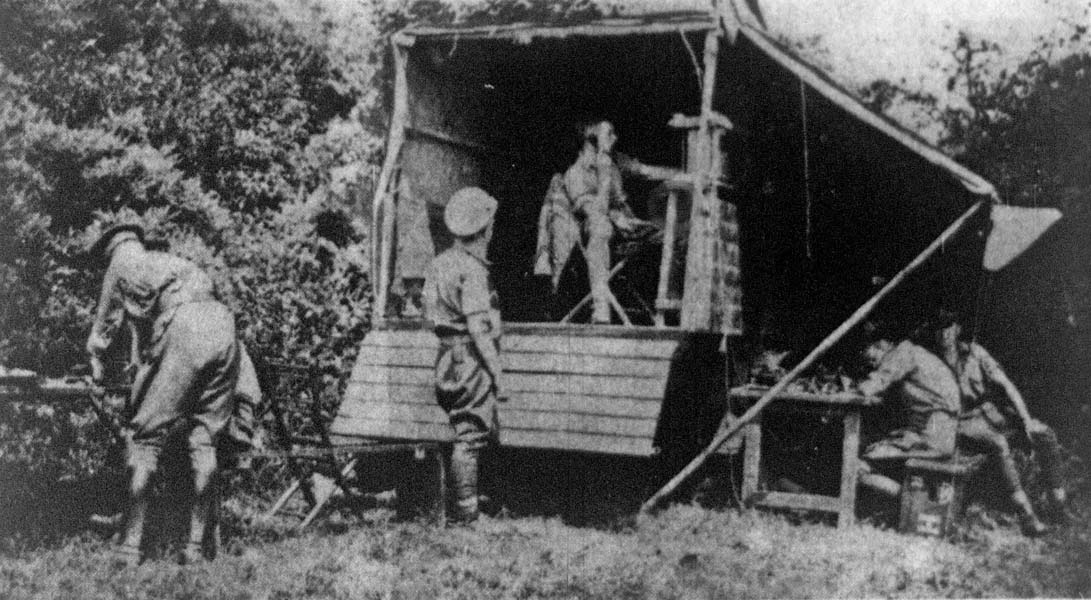
A telephone station of the defending force well screened by thick foliage.
Photograph from the Brighton & Hove Herald on 10 August 1935.
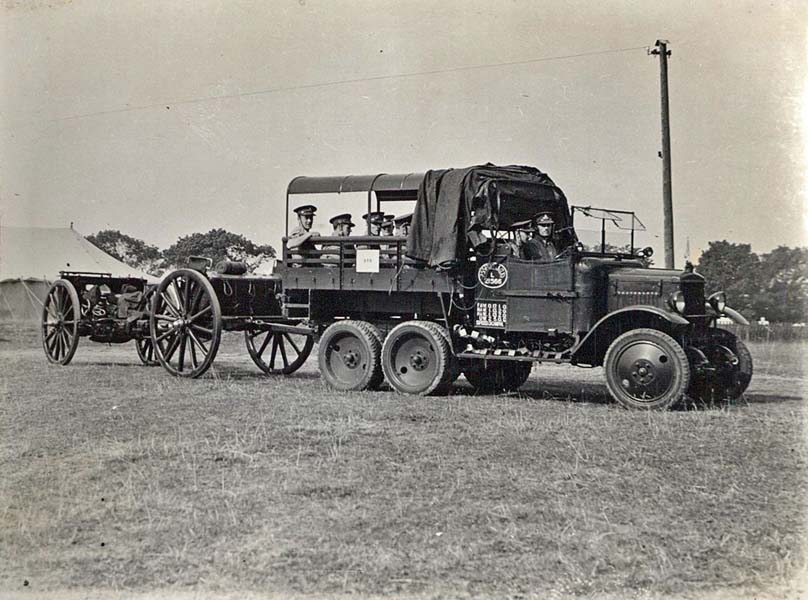
An army lorry towing a field gun at the Territorial Army Camp at Falmer in August 1935.
Keep reference: BH/A/54/01_0093a
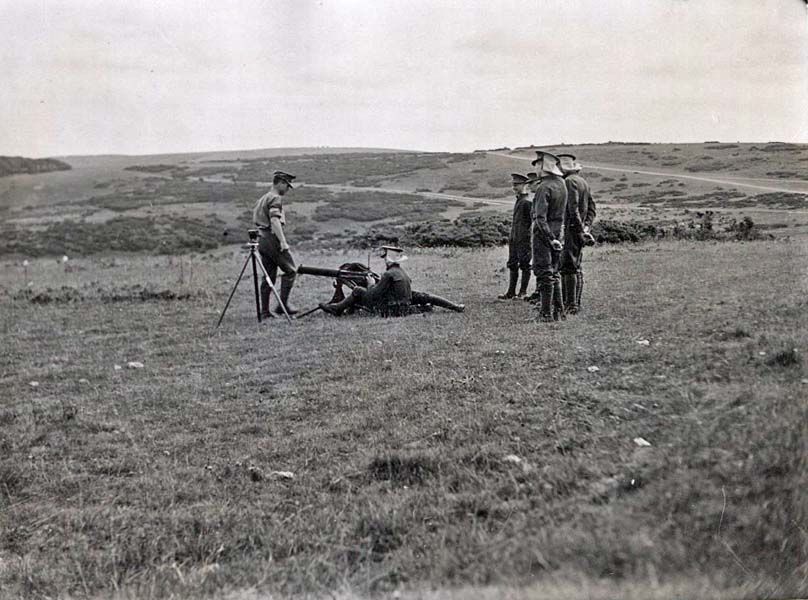
Gunnery practice at the Territorial Army Camp at Falmer in August 1935.
Keep reference: BH/A/54/01_0119b
All images copyright East Sussex and Brighton Records Offices at the Keep.
Territorial Army Stories Continued
The ceremony of “Beating Retreat” on the Madeira Drive yesterday (Friday) evening.
Keep Reference: BH/A/54/01_0052a
2000 Territorials in Mock Battle
Hollingbury Camp as “Objective”
Airplanes and Guns
Over 2000 territorials are to take part on Wednesday and Thursday next in the mock battle on the Downs near Brighton.
Airplanes and light and heavy artillery are to be used in the battle which will rage throughout Wednesday through part of the night and end on Thursday. It is hoped that armored cars will be used.
The men taking part are London Territorials in camp at Falmer.
The Herald was informed by Colonel C F Liardet D.S.O. officer in command, that Ditchling will be the centre of the operations and the battle will move towards Brighton, reaching its final stage at Hollingbury Camp which is the last objective.
Colonel Liardet will be in charge of the battle by means of wireless and field telephone. Special cables have been laid for the phones and the control will also keep in touch with the brigade commanders by direct wireless communications. Sets for both transmission and reception by direct speech are carried in baby cars attached to each unit.
Aerial Spotting
In the battle over 50 guns of calibers ranging from 18 pounders to 60 pounds will fire blanks while airplanes will carry out reconnaissances and take photographs of the movement of the different units. By this means the officers will be able afterwards to see how each unit carried out its own operations; the photographs, in fact, will form an incontrovertible record of the work performed whether good or indifferent. Each battery officer will be on his toes to see that the aerial eye does not observe any of his errors of omission or commission. Some of the batteries will be camouflaged against observation It remains to be seen whether they will be spotted from the air.
This is believed to be the first occasion on which territorials have taken part in manoeuvres of this magnitude.
During Wednesday night the men will go into bivouac on the open Downs. Now they are hoping the weather will be will keep fine!
All Mechanized
The operations are for the first time all mechanized. No horses are to be used except by the officers in fact the artillery is now almost completely mechanized. The change was noticeable in the camp where large and small motor trucks stood in orderly rows. There are about 200 vehicles of all kinds.
The jingle of the bits and the spurs have given way to the grunt of heavy engines and hum of motor tyres.
The units in camp include the 63rd, 64th and 65th Field Brigades R.A., The 47th Division signals, the 21st, 22nd, 23rd, And 24th Battalions, London Regiment (comprising the 142nd Infantry Brigade), the 47th Divisional R.A.S.C., the Second Cavalry Divisional R.A.O.C., and the 222nd Company, R.E.
Actually, there are two camps, one on either side of the main road. Their white canvas tents can be seen from the buses extending in orderly lines over the Downs. The second camp comprising the infantry and the signals, is under the charge of Colonel M. Beckwith-Smith D.S.O., M.C. On Sunday other territorial units are to enter camp at Roedean.
“Beating Retreat”
About 5000 people watch the band of the 23rd Battalion of the London Regiment beating retreat on the Madeira drive yesterday (Friday) evening.
The 23rd are in camp at Falmer and by permission of Lieutenant Colonel W. H. C. Le Hardy, M.C., the bands perform the ceremony before the Mayor and Mayoress of Brighton Alderman and Mrs. Gibson and members of the Brighton Town Council.
The Councillors, together with the Chief Constable Captain W. J. Hutchinson and Mrs. Hutchinson and other privileged spectators, watch the ceremony from the Aquarium Sun Terrace, while scores of holiday makers line the sides of the road.
Military parades are always entertaining and the crowd were thrilled by the rhythmic marching of the bandsmen in their scarlet uniforms and white gauntlets the twirling of the drum major staff and the feats of legerdemain performed by the drummers.
The performance will be repeated next Friday.
Territorials have arrived at their annual camp at Falmer.
A general view of the artillery camp.
Keep reference: BH/A/54/01_0052b
From the Brighton and Hove Herald on Saturday 3 August 1935
BRIGHTON CAPTURED
Theoretically
Invading Army Wins Battle Of The Downs
Grim Machine War
A survey section ready to move off at Falmer.
Keep reference: BH/A/54/01_0060a
A nice little war in which no blood was shed and guns spoke with a bark far worse than their bite ended with the capture of Brighton theoretically speaking on Thursday.
A force from the mythical kingdom or is it a republic of Francoma succeeded in pushing defending forces into the sea in the early hours of the morning. Following a campaign which began in the near neighbourhood of Lewes on Wednesday.
The force of 2000 London Territorials who are in camp at Falmer took part in the battle which was staged with the idea of testing the efficiency of the newly mechanized Territorial Army. Judging from the satisfaction of the Gunnery officers on Thursday the results of the test were highly satisfactory. They were perhaps less satisfactory to the small force of infantrymen who after fighting gallantly throughout, discovered that, technically, they had been wiped out long before.
It was, in fact a campaign which would have given satisfaction to a Pirandello who might have christened it “2000 Territorials in search of a war.”
Small parties of infantrymen had to represent whole divisions, and more than one soldier had the responsibility of personifying a company of men in this mock battle, in which there were only imaginary casualties, the size of which was a matter for the skilled judgment of umpires who accompanied the different units. The umpires’ reports were not expected before the weekend, but an officer attached to the staff of Colonel C. F. Liardet, D.S.O. commanding the Artillery forces, estimated that theoretically 50% of the defence forces were annihilated, while the attackers lost some 25 per cent.
The Attack Opens
The attacking force representing the Franconian invaders were assumed to have landed at Pevensey and have reached, on the evening of August 6th, the district of Lewes. The following morning the attack developed when defenders screen of cavalry was observed.
A gun crew awaiting the signal to advance, note the gorse and bracken used to try to camouflage the gun.
Keep reference: BH/A/54/01_0051c
A battery of guns were brought into action the cavalry were driven off and soon in rapid succession Horseshoe Plantation, Street Hill Farm and Mary Farm all objectives within a few miles of Falmer fell before the advance of the invaders.
These skirmishes however were only preliminaries to the main battle which developed in the afternoon near Ditchling Beacon. Here a defending battalion which actually represented a whole division, was met in a strong position at noon. The invaders threw Practically the whole weight of their artillery into the battle comprising some 44 light and heavy guns and at 3:30 the beacon was captured.
In spite of counterattacks the Franconia’s pushed on, at 4:00 they came up against the main enemy position, situated on high ground with upper standing as the centre and it was decided that this position could not possibly be taken that evening.
Accordingly, the forces both attacking and defending Bivouac on the Open Downs while the invaders were preparing for their final attack. Actually, the only work during the dark house was done by signallers, who were busy laying their telephone wires and experts who were preparing by secret survey methods for the artillery attack in the morning. Although this was an official secret, the survey may be described as a new method by which guns can be trained on a target without preliminary range finding shooting the most that could be gathered about it was that it all were it is all worked out by trigonometry.
With dawn, the great offensive was launched. All the invaders’ artillery began to hurl imaginary projectiles onto the defenders’ position, and by six o’clock the whole area north of Upper Standean had been captured. The artillery fire was represented by the firing of 200 rounds of blanks which was quite impressive.
Signal practice at the Territorial Army Camp at Falmer.
Keep reference: BH/A/54/01_0051b
A Theoretical Army
Actually, it hardly mattered what was used, for the infantry who had been representing the defenders had been sent back to camp the night before, and the positions were occupied only by a theoretical army. Still, this army was yet theoretically strong enough to decide the attacking commanders in calling off the battle soon after six in the region of Tegdown Hill above Patcham.
There were a number of domestic reasons for this decision, but it appears that had the attackers continued, the defending force would have been overwhelmed. Hollingbury Camp (the last theoretical stronghold) would have been taken, and shortly afterwards Brighton would have been at the mercy of the invaders.
This as briefly as possible is the story of the tactics of the battle. From the point of the spectacle it was evident that the Territorials had lost a great deal of the picturesque by mechanization. It was a grim war machine The few horses to be seen were ridden by dispatch riders or officers.
There was none of that dashing work by cavalry which had provided the painters with such dramatic subjects in the past One could see only green painted wagons drawing field guns moving uncouthly across the downs or concealed behind clumps of trees from observation by the defenders airplanes.
Here and there were little groups of soldiers talking into field telephones or signaling motorcyclist and little green cars carrying portable wireless sets dashed about, giving some animation to the otherwise almost static scene.
The holder force was lost on these thousands of acres of gorse strewn sand bleached Downland. The attacker’s orders were to remain concealed as much as possible and at no point was it possible to see more than a few men or machines.
Camouflaged Guns
Only the observer in his cockpit might have been able to descry anything more, and to deceive him the gunners had tied fern and gorse all over their machines.
There was something forbidding about this mechanical war, in which the human element seemed to count for so little. One wonders what the reality might have been, with its addition of formidable tanks and poisonous gas. And one came to the conclusion that the best kind of war was the Territorials, which ended with the theoretical victory of one side or another, according to the umpires decision.
And as it was arranged that the attacker should win, everybody was happy!
A telephone station of the defending force well screened by thick foliage.
Photograph from the Brighton & Hove Herald on 10 August 1935.
An army lorry towing a field gun at the Territorial Army Camp at Falmer in August 1935.
Keep reference: BH/A/54/01_0093a
Gunnery practice at the Territorial Army Camp at Falmer in August 1935.
Keep reference: BH/A/54/01_0119b
All images copyright East Sussex and Brighton Records Offices at the Keep.
Territorial Army Stories Continued
